Saturday, January 18, 2014

Hiking Korea's Tallest Peaks: #2 - Jirisan


     Next up on our tour of Korea's tallest peaks is Jirisan.  Sarah and I left from the Suwon Bus Terminal on a rainy Saturday morning in early November, hoping to catch the last of Korea's famous fall foliage.  Our destination was Jinju, a small city in South Gyeongsang Province, and a popular entry point cities to hike Jirisan's peak.  After about a 4 hour bus ride, we made it to Jinju, however our journey had just begun.  We still needed to get to Jungsan-ni Village (about another hour away) and hopefully find availability at one of the minbaks (guest house) there.  We made our way to the other bus terminal in Jinju, forgot to transfer to a different bus so we spent some time with the driver until he started his route back the other way.  He was nice enough to share some of his rice cake snack before taking us back to the transfer point to catch the other bus to Jungsan-ni.
     Luckily enough for us, we were able to find a room at one of the minbaks in the village for only about 30,000won, or $30.  We had an early morning ahead of us so we cozied up on the floor (most of the minbaks I've stayed in don't have beds) for a good nights rest.
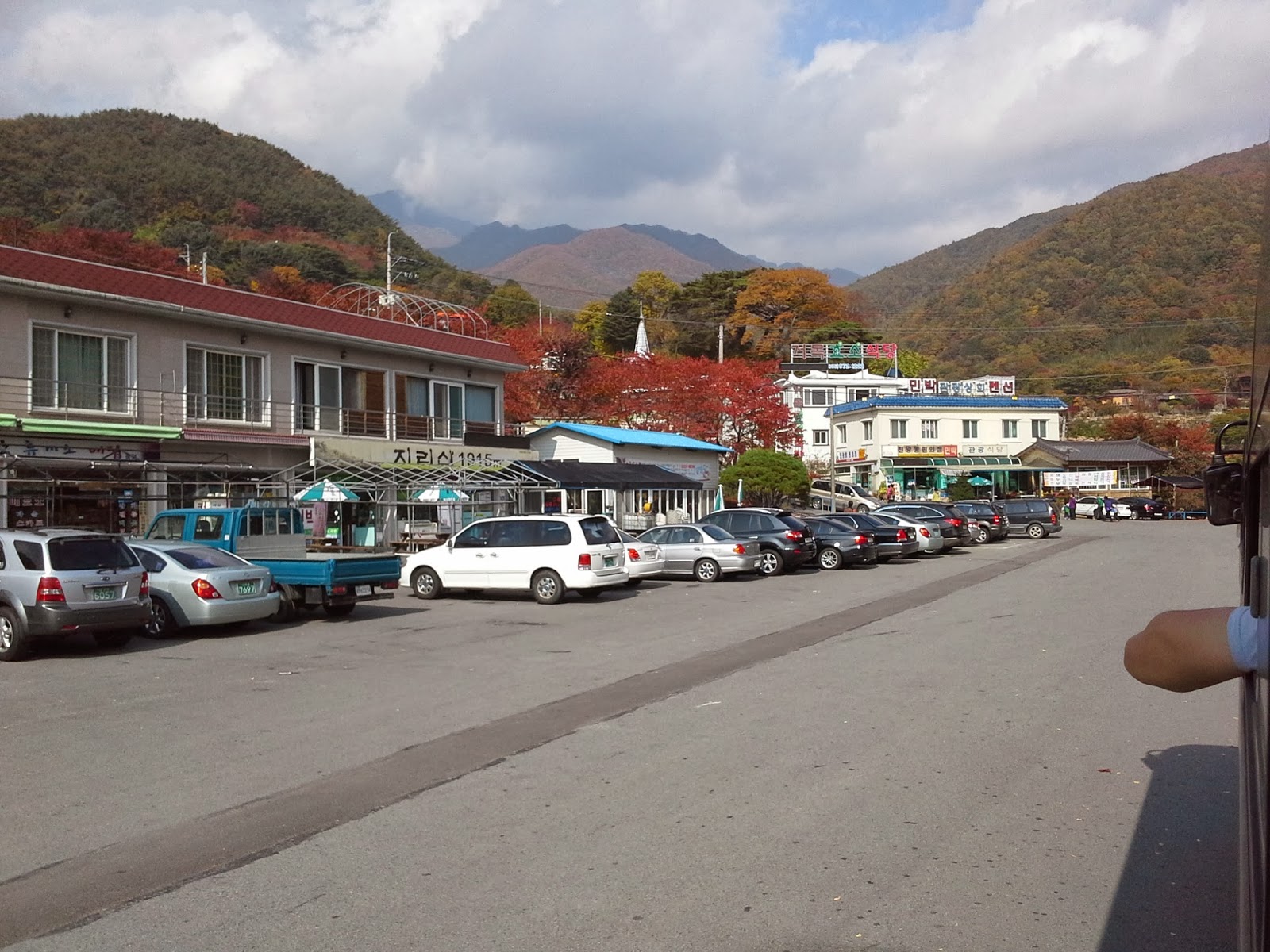
Jungsan-ni Village
Jirisan National Park (elevation 1,915m or 6,282ft)
     Jirisan was the first designated national park in Korea and is considered to be one of the most sacred mountains in the country.  The national park stretches across 3 provinces and has a lot of areas that are off limits to hikers for safety reasons.  
     Unlike Seoraksan, you don't have to hike a through valleys and riverbeds before starting your accent to the top.  The quickest and easiest route up to Cheonwangbong peak (천왕봉) starts from Jungsan-ni which is at the base of the peak.  We woke up around 5:000am Sunday morning so that we were sure to finish our hike with enough time to catch our bus back to Seoul later that afternoon.   It's about a 1.5km walk up a winding road from the village to the trail entrance.  Luckily for us, a bus full of hikers was about to start their hike too and offered to give us a ride to the trail entrance, saving us about a 30minute walk.
    
          This particular hiking trail is 12.4km round trip and takes about 9 hours to complete.  It was still pretty dark when we started on the path and the sun finally woke up around 7am giving us the opportunity to enjoy all of the beautiful colors.  We made really good time up the mountain and reached the peak by about 9am.  We had more time to enjoy the foliage on the hike down the mountain and the trail was surprisingly less crowded than we were expecting.  Jirisan is a beautiful mountain but we would've needed a few more weeks to have enjoyed everything it has to offer.  Stay tuned for the last and tallest mountain to complete our tour of Korea's tallest peaks!

Sunday, January 12, 2014

Hiking Korea's Tallest Peaks: #1 - Seoraksan

    If Virginia is for Lovers, South Korea is definitely for hikers.  Being in a country that is about 70% mountain, it's to be expected that hiking would be a popular hobby for it's residents of all ages.   
     "San" is Hangul for mountain and you'll see those three letters tagged to many directional signs throughout the country.  Every day of the week, at all hours of the day, you'll see Koreans decked out in their gaudy hiking gear, excessively full backpacks and hiking poles ready for a day outdoors.  Our first "real" hiking adventure was at Seoraksan National Park, and after visiting, Sarah and I decided we wanted to try and conquer Korea's three tallest peaks.   
     Luckily, we were able to reach the third and highest 봉 last weekend so I wanted to share our experience, hiking Korea's three tallest peaks: Seoraksan, Jirisan and Hallasan.  Albeit strenuous and time consuming, all three were accessible in a day's hike, with no overnight camping required.  First up...Seoraksan!

Seoraksan National Park (elevation 1,708m or 5,603ft)
     Seoraksan is the highest mountain in the Taebaek mountain range located in the northeastern part of the country with Daechongbong Peak (대청봉) as it's highest peak.  It's probably the most popular of the three, even though it's the smallest.  Seoraksan is about a 3-4 hours from Seoul by bus and tends to be a little crowded, given it's location.  There are trails for every skill level but if hiking is not your thing, you can visit a Buddhist temple, see a couple of waterfalls or ride a cable car that'll take you to the top of a smaller peaks to enjoy the views without breaking a sweat.  Sarah and I visited the park twice and opted to traverse two of the more difficult but rewarding trails. 


     On the first day, we decided to climb up one of the most popular rock faces in all of Korea - Ulsanbawi.  We had to climb over 800 steps to make it to the top but had the chance to see a Buddhist Temple in a cave on the side of the mountain and burn a day's worth of calories.   We walked around the park a little longer afterwards but didn't do much more so that we could conserve our energy for day two. 
Stairs, stairs and more stairs...

The view from the top


Buddhist Temple Cave on the climb up to Ulsanbawi
     Day two was an early one to make sure we had enough time to make it to the peak and back before the sun set.  Since we were up so early, we caught the sunrise before making it to the park around 7:30am to start our 12hour round trip hike to Daechongbong Peak.  The course we took was a recommended 2 day course (16km round trip) but with the early start, we were sure to finish in one day.  
     Of the three tallest in South Korea, I thought Daechongbong was the most difficult to reach, mainly because we had to hike at least 3 hours before we started the intense climb up to the peak.  Hiking 800+ steps the day before probably factors in a bit too.  Either way, hiking through the valleys made me feel like Frodo from Lord of the Ring.  It was absolutely breathtaking and was a surreal experience.  We pushed ourselves a bit and made it to the peak and back in about 10 hours.  It was mid-September so we still had some daylight but another two hours and we would've been hiking the last leg in the dark.  
     All in all, Seoraksan was an amazing experience and a must visit for anyone spending an extended amount of time in Korea.  We easily could've spent another day hiking around to the different waterfalls and other trails, but the two days of hiking took it out of us.  Next time I'm in Korea, I'll definitely try to go in October to really experience Seoraksan and all of the fall foliage she has to offer.  

     Stay tuned for Jirisan and Hallasan in the coming weeks...
Cable car ride for the less adventurous
The final kilometer to the peak.  Also, a
shelter for those making it a two day trip
Love this picture of Sarah :)
Almost to the peak!
We made it!!
The beauty of Seoraksan is that the closest town to stay and play in is Sokcho.
It's on the east coast so you can enjoy the beautiful blue waters of the East Sea.
After all of the hiking we did, I definitely think we deserved a beer on the beach


Sunday, December 15, 2013

Korea's Traditional Markets - A Peak into the Past

One of the things I enjoy the most about being in Korea is visiting one of the many traditional markets sprinkled throughout the country.  You can find a traditional market in almost everyone of Korea's cities and I think it's a great way to experience the culture and see how the country's markets use to operate throughout it's history.  
     I love the scents, sounds and sights that welcome you from the moment you step foot in the market.  To be honest, some of the smells are a bit pungent but it makes for a memorable experience nonetheless.
     Three of the major markets in Seoul are Namdaemun, Dongdaemun and Moran Market.  All have their own character, speciality and atmosphere that distinguish them from one another.  
     Namdaemun is probably my favorite of the three and is located by the "Great South Gate" of Seoul.  It's feels the most authentic with it's winding streets, numerous alleys and wide variety of things for sale.
    I've only been do Dongdaemun (also known as the Mecca of Fashion) a couple of times, but it's much bigger than Namdaemun.  While Namdaemun is mainly an outside market, Dongdaemun is predominately indoors and consists of a number of different buildings.  There is an outside market at Dongdaemun as well, but most of the action is within the many buildings scattered around the East Gate of Seoul.  In those buildings, you'll find floor after floor of clothing, jewelry, appliances, bedding, etc.  Starting at 10pm, you'll find rows of yellow tents outside, opening their flaps for business.  You can take advantage of the shopping deals through the night, until they close up at 5am.  The crowds during the late hours are impressive to say the least.
Outdoor Market
Indoor Market
     The last, and most recent market I've visited is probably the most unique.  Moran Market is south of the Han River in Seoul and only operates on the 4th, 9th, 14th, 19th, 24th, 29th day of every month from 7am-7pm.  What makes this market more unique and culturally interesting is the buying and selling of live animals.  Everything from goats, chickens, ducks and even dogs.  Not more than 25 feet from the main road you'll see cage after cage of live animals for sale.
     They also have pets that you can buy, along with produce, clothes, tools, appliances, etc. similar to the other markets I've mentioned.  Some parts of this market were a bit disturbing, but it is definitely the most interesting one I've ever seen before.  I won't post all of the pictures from Moran Market, but if you were interested in more, you could probably just do a Google Image search on your own.
     All in all, Korea has a lot of character and culture to offer and one of the best places to experience both are in the markets.  Go often, visit as many as you can and enjoy the sensory overload that comes with it!
Puppies you can buy as pets.  Just put them in a box and take one home!

Friday, November 1, 2013

Templestay in Golgulsa & Home of Sunmudo Templelife

I was finally able to take advantage of one of the many Buddhist templestay programs in Korea a couple of weekends ago.  Not that I'm trying to convert or anything, but it seemed like such an interesting experience and has been something I've wanted to do for a little while.  An ideal opportunity unexpectedly presented itself so I took advantage of it...

Gyeongju, GyeongBuk Province, is located in the southeastern corner of Korea and was capital of the Silla Kingdom (57 BC – AD 935), which was ruled by 56 kings over 992 years, the longest period of any dynasty in the history of Korea.  This bustling city, with over 2,000 years of history, was my destination to partake in my first templestay at Golgusa, home of the Buddhist martial training methodology call Sunmundo.
     It was only about a 3 hour train ride thanks to Korea's phenomenal transportation network and then another 45min bus ride from Gyeongju to the temple.  Korea has nearly 1,000 buddhist temples so it was hard to decide on which program to try out, but the martial arts background of Golgulsa was enough to put it atop of my list.  
     I checked around 4pm on Saturday and was given my clothes for the weekend and a key to my room.  Given limited space and the popularity of the program, I shared a room with another English teacher who had been there several times already.  It helped to have someone familiar with what I was getting myself into, and was also comforting to know that Golgulsa was doing something right if they have repeat customers!
      Another draw of coming to this temple was the Martial Arts Festival that was taking place on the Sunday I'd be at the temple.  It seemed like the perfect storm and there I was, ready to take it all in!
      About an hour after arriving to the temple, I enjoyed vegetarian dinner, rice, vegetables and soup, and then headed up to the orientation at the main temple, a quarter mile up the mountain from the main gate.  The highlight of the night was the Sunmundo Training we were able to participate on Saturday, led by one of the monks.  Sunmundo,  literally meaning “the way of doing meditative martial arts” is a combination of yoga and some basic martial arts moves (kicks, punches and defensive poses).  It's amazing how much slow and methodical movements can wear you out.
     Training lasted almost 2 hours and I was in bed by 10pm for lights out.  I would need the sleep given the 4am wake up time on the schedule.
     The last thing I wanted to do was be late for the 4:30am chanting service...if you can read the fine print, penalty for such a thing is 3,000 bows.  I wish I would've gotten some audio of the chanting because it was kind of cool and parts of it had a good beat.  After about 30 minutes of uncomfortable meditation, we did our slow meditative walk down the mountain where we were cut short because of the monks' festival preparations.
     Later in the morning, we had tea with one of the senior monks and had a chance to ask him some questions about temple life, Sunmundo, etc.  Even though a couple of the activities were cut short or didn't happen, what I was able to experience was enough for me!  The temple grounds were pretty amazing too with it's highlight being a buddha carved on a large piece of granite high above the temple entrance.
     Overall, it was a great experience and I'll probably try to do another, more authentic one before leaving.    Golgusa is well worth the visit, along with everything else that Gyeongju has to offer.  Enjoy a few more pictures from the trip and thanks for reading as usual!
 
I was awake up 4am so there was no way I was going to miss the sunrise
The cornerstone of the temple and was carved almost 1,500 years ago